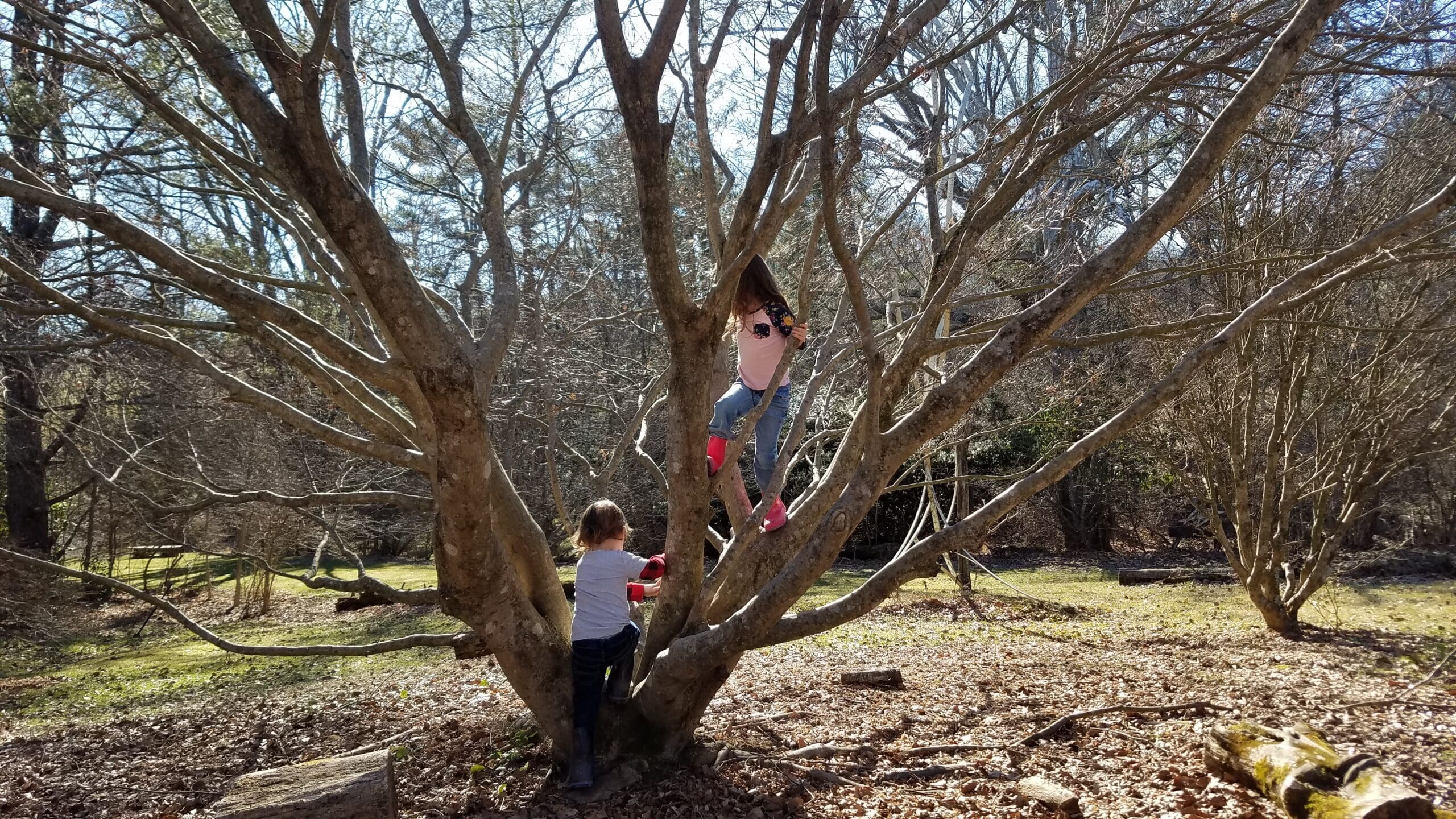
So much of our learning happens outside.
Not because I planned it that way…
although, if I’m honest, I do.
But only because that’s where curiosity naturally lives.
It’s hard to manufacture curiosity at a table.
But outside, it rises up on its own.
What Learning Looks Like For Us
It looks like pausing to listen for birdsong,
tilting our heads to catch the difference between one call and another.
It looks like flipping through library books later, trying to match what we saw to a name.
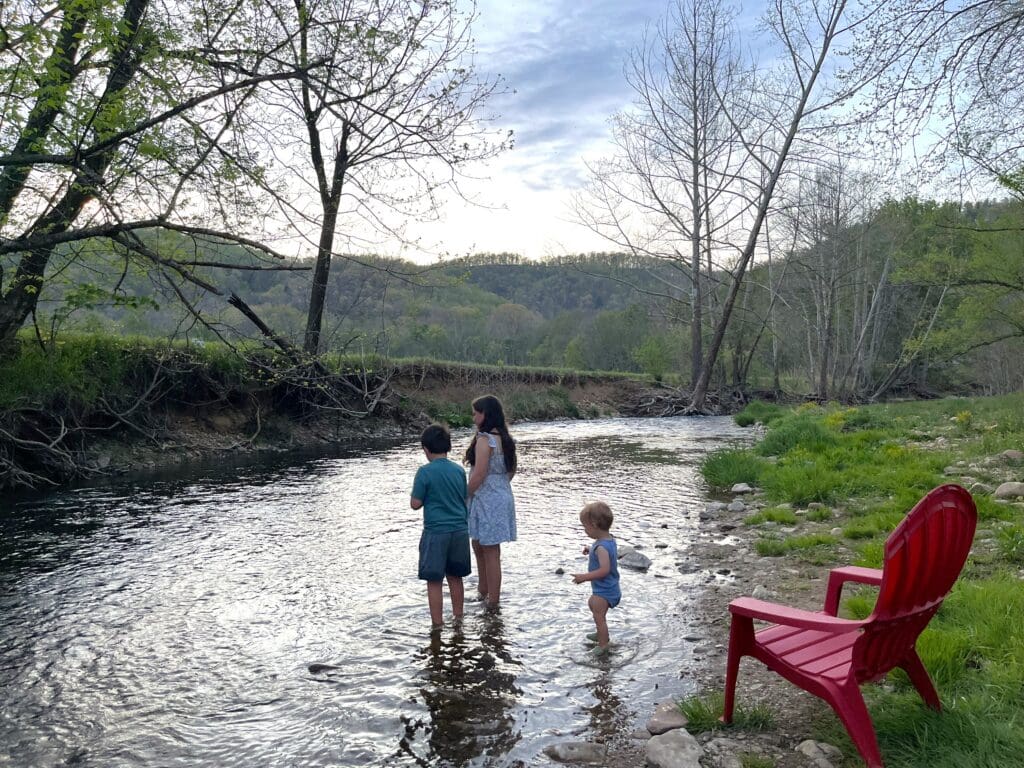
It looks like long river days—
feet in the water, hands turning over rocks,
finding tadpoles and crayfish (or “crawl dads,” as we call them),
watching how the current moves, how the land is shaped over time,
and wondering where this river will eventually go… all the way to the ocean.
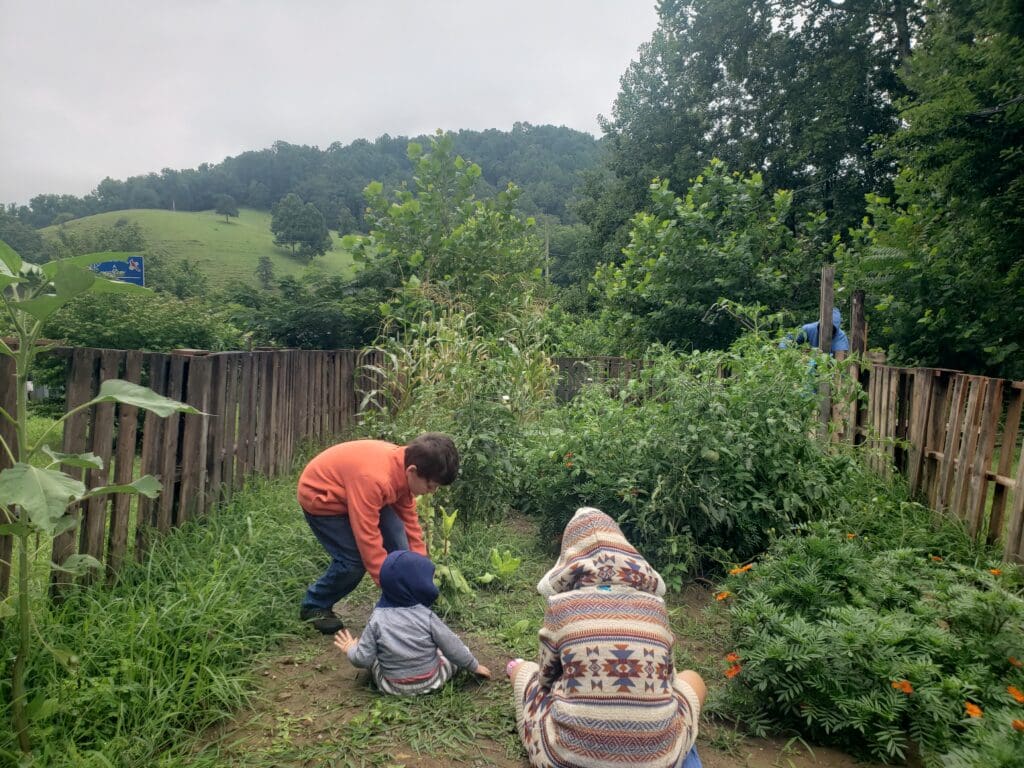
It looks like planting seeds and waiting.
Checking for sprouts.
Noticing the bees.
Learning, slowly, how life unfolds from the soil up.
It looks like the quiet noticing of seasons—
the first blooms in spring,
fireflies in the thick of June evenings,
leaves turning without asking permission.
When Learning Becomes a Way of Living
It looks like watching the sky shift before a storm,
or stepping outside to see frost covering the ground in the early morning light.
Sometimes it’s as simple as recognizing a set of tracks in the mud,
and stopping long enough to ask, who was here before us?
And sometimes… it just looks like bringing schoolwork outside
because the breeze is too good to ignore.
Even the ordinary rhythms around us become part of the learning—
hay being cut in nearby fields,
cattle grazing,
gardens coming back to life.
These are the moments where learning stops feeling like something we do
and starts feeling like the way we live.
And our rhythm follows the seasons.
In the warmer months, we’re outside more—
moving, exploring, touching everything we can.
In the winter, we naturally draw inward—
books piled nearby, games on the table, documentaries playing in the background.
Nothing is forced.
It shifts as nature shifts.
Following Curiosity (Where It Leads)
Recently, we found two sets of animal tracks down by the river—
one from a white-tailed deer, the other from raccoons.
That small moment turned into something more.
We talked about hunting season,
about how deer meat provides for our family.
We checked our solar cameras and saw raccoons sneaking into the chicken feed.
We started looking up ways to keep them out…
and somehow ended up learning that raccoons are as smart as a three-year-old.
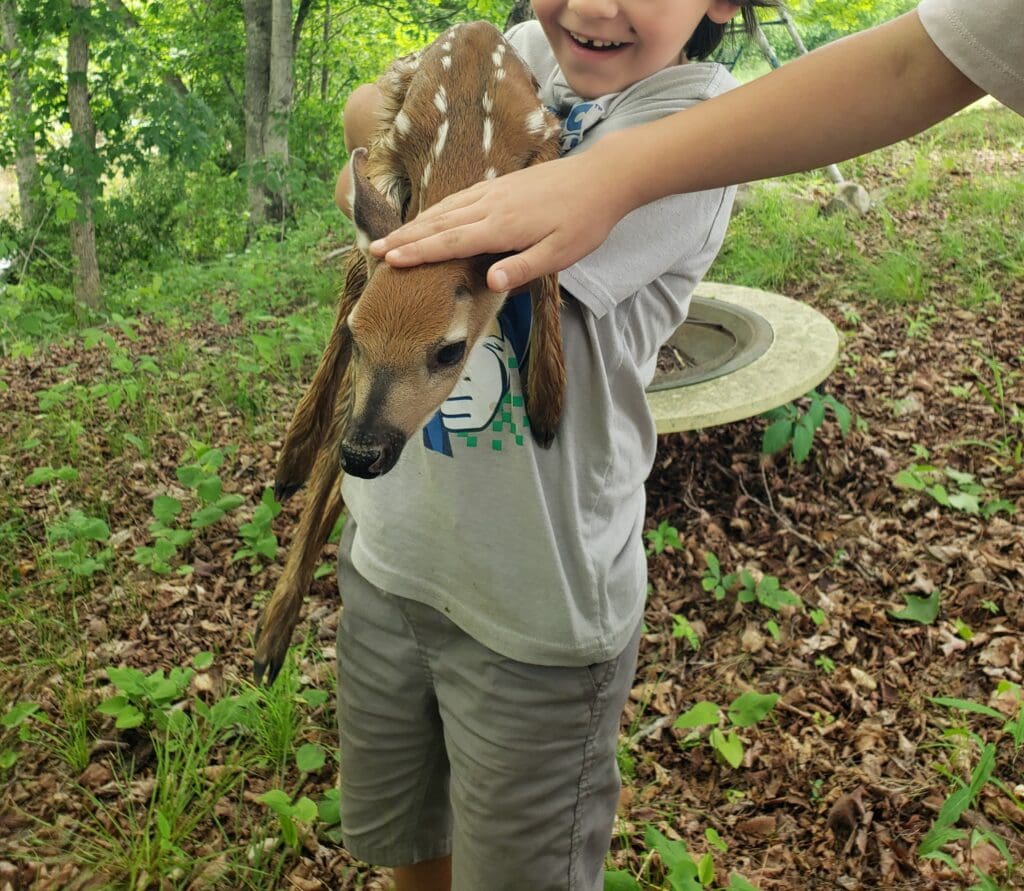
Over the summer we even rescued this little fawn from the river.
That’s the thing about this kind of learning—
it leads somewhere.
The Kind of Learning That Stays
Hands-on learning sticks.
It settles deeper.
It becomes part of who they are.
Fresh air over filtered air.
Hands in the dirt over hands shuffling through sight words.
Curiosity leads them to look closer—
both with us and on their own.
And over time, it builds something steady:
confidence, awareness,
a rhythm for lifelong learning.
It Doesn’t Have To Look Like School
It doesn’t have to look like school to be school.
And I truly believe this—
God designed children to be curious.
We’re not creating that in them.
We’re just protecting it. Nurturing it. Making space for it to grow.
The whole world outside is a classroom.
We’re just here to explore it with them.
The Books That Follow Us Back Inside
Over time, we’ve collected a small stack of nature books that we come back to again and again.
Nothing fancy—just the ones that have ended up worn, flipped through, and sometimes carried outside with us.
🌿 The Nature Books We Keep Reaching For
These are the ones that tend to stay within reach around here—flipped through often, sometimes brought outside, and usually opened because a question led us there.
- Nature Tonic: A Year in My Mindful Life — more of a slow, reflective guide with simple prompts that help us notice what’s right in front of us: Link https://amzn.to/3QVNnZV
- Trees, Leaves, Flowers and Seeds: A Visual Encyclopedia of the Plant Kingdom — this one gets opened a lot when we’re trying to name what we’ve found: Link https://amzn.to/4taKC4A
- Insect Anatomy: The Curious World of Bees, Beetles, Butterflies, and Bugs — a favorite for bug discoveries, especially when curiosity turns into lots of questions: Link https://amzn.to/42HKQoK
- Nature Anatomy: The Curious Parts and Pieces of the Natural World — one of those books that makes you slow down and look closer at everything: Link https://amzn.to/4uo5ar1
- Ocean Anatomy: The Curious Parts & Pieces of the World Under the Sea — we don’t live near the ocean, but somehow this still gets pulled out often: Link https://amzn.to/3OQ5KPr
- Wildlife Anatomy: The Curious Lives & Features of Wild Animals Around the World — a fun one to flip through when the kids start wondering about animals beyond what we see here: Link https://amzn.to/4tSWhpU
- The Julia Rothman Collection: Farm Anatomy, Nature Anatomy, and Food Anatomy — this one overlaps a bit with what we already have, but it’s a favorite to revisit: Link https://amzn.to/4uo5eXN
- National Geographic Backyard Guide to the Birds of North America, 2nd Edition — the one we grab when we’re actually trying to figure out which bird we just saw: Link https://amzn.to/4uonXCS
- Gardening Lab for Kids: 52 Fun Experiments to Learn, Grow, Harvest, Make, Play, and Enjoy Your Garden — helpful on days when we want a little direction but still stay hands-on: Link https://amzn.to/4tODhJ3
Some of these are affiliate links, which means I may earn a small commission at no extra cost to you. We only share what we genuinely use and love.
Even with the books, most of our learning doesn’t start there.
It starts outside—
with a question, a moment, something we didn’t plan.
The books just help us stay with that curiosity a little longer.
And more often than not, it leads us right back out again.
I’d love to know—
what does learning look like in your days right now?
Not the ideal version… but the real one.

LEAVE A COMMENT
Comments